
Q: How did Marshall Curry and Matt VanDyke meet?
Marshall Curry, director: One day I got an email out of the blue from a guy who said he’d recently returned from Libya and thought his story would make a good documentary. Soon after, he and his girlfriend Lauren came to my office in New York and met with Elizabeth Martin, my frequent producing partner (and wife), and me. They told us Matt’s story and we were hooked.
Matt was a fascinating person — provocative and hard to pin down. Was he Lawrence of Arabia? Don Quixote? Christopher McCandless from Into the Wild? Ernest Hemingway in the Spanish Civil War? Timothy Treadwell in Grizzly Man? Or some combination of them, who — like all of us — changed and morphed over the course of his life?
His story was filled with thorny questions about the morality of war, the lure of adventure, the tension between idealism and ego, the way we define “manhood,” and the way we use cameras and social media to craft our images.
I love stories and characters that are not black and white, and sparking conversations about tough questions is one of the main reasons I make documentaries. So Elizabeth and I thought, “Let’s make a film that replicates the experience we just had, where the audience sits down with a stranger and hears an amazing, controversial story — and then walks out of the theater to grapple with it.”
I asked Matt to send me his footage, and when I watched it, I was amazed by the access he’d had to the war and to a world that most outsiders had never seen. So a few months later I did the first day-long interview that makes up the spine of the film.
Q: How much did you shoot? How long did it take to edit?
Curry: Over two long days, I shot twenty-something hours of interviews with Matt. Later we did a few hours of audio pick-up interviews. Matt had shot over a hundred hours of footage during his travels, and it took my team and me around a year to shape that footage and the interviews into a movie.
Q: Starting with the film’s title, Point and Shoot, there seems to be a curiosity in this film about the power of cameras. What interested you about that?
Curry: As a documentary filmmaker, I think a lot about how cameras capture reality and also how they shape it. When Matt began his journey — his “crash course in manhood” — he tried to project a braver, more confident version of himself for his camera, even taking on a cooler, tougher nom de guerre, “Max Hunter.” But as he explains, over time, he actually started to become the character he was playing on film. The filming somehow made it real.
Kurt Vonnegut said, “We are what we pretend to be, so we must be careful about what we pretend to be.” And this is true whether we are making theatrical documentaries or simply snapping selfies for social media. The images we create can affect who we actually become.
In Matt’s footage, we see American soldiers in Iraq doing the same thing, performing for his camera during a raid, self-consciously kicking open a door in an attempt to look like the soldiers they’ve seen in movies. And Libyan soldiers did this too. Even as they engaged in dangerous acts of self-sacrifice, they wanted to have footage of themselves looking like the Hollywood action heroes they grew up watching. At the end of the war, some rebels even filmed gruesome “selfies” of themselves at Gaddafi’s killing.
As I edited the hours and hours of footage, I began to notice the power of homemade images in almost every scene, from the Australian adventure footage that inspired Matt’s initial journey, to the Arab Spring activists whose cell phones didn’t just document their revolutions, but drove them.
Matt found that putting a frame around an experience turned it into something he could control, and he even used his camera to help manage his obsessive-compulsive disorder. Toward the end of the film, he explains that even though he’d been a part of the Libyan rebellion for months, it was seeing himself on TV that truly validated his role as a rebel fighter. Television made it real.
Q: Why did you film the interviews in his apartment and in a messy kitchen rather than in a more traditional interview setting?
Curry: I knew from the beginning that I wanted the film to feel informal and intimate, like when you meet someone in a bar or on a long bus ride, and they just spill out their tale to you. I wanted to strip away anything that felt too slick or glossy and give the audience the feeling that they had just stumbled into this home and met these people.
I also decided from the beginning that I wanted to structure the whole film around a single voice in what feels like a single interview. I loved the way that The Kid Stays in the Picture and The Fog of War had done that, and thought it would invite the audience to question the narrator and interpret the story for themselves, rather than have the film interpret everything for them.
Q: Why did you end the film the way you did — with an unanswered question?
Curry: The first time I met Matt I thought he was a fascinating character whose story raised all sorts of unanswerable questions. I hoped that ending the film with a question would invite the audience to leave the theater — or turn off the TV — and hash out those questions with each other. After the film’s premiere at Tribeca, I went across the street to have dinner and overheard two separate tables where people were shouting at each other about the film — which was music to a documentarian’s ears.
Q: [Spoiler alert] Did Matt get his camera back with footage after he was captured?
Curry: No — Matt’s captors took his camera, and he never got it back. Fortunately, however, just a few days before he was captured, he had backed up his footage on a hard drive and stashed it in Benghazi. That’s how we have all of the footage leading up to his capture. When he was released, he bought a new camera, which is how we have all of the footage afterward.
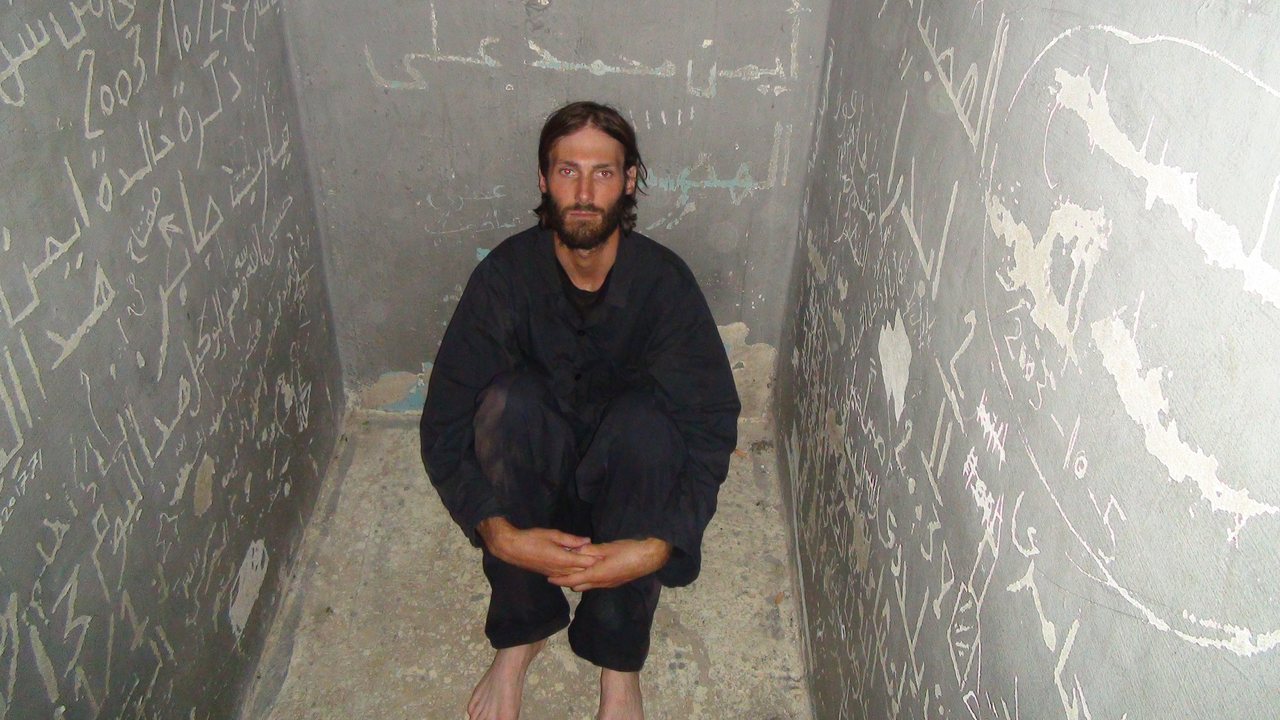
There is no footage of Matt in prison, though, so I decided to use animation to illustrate that period. After the war, Matt had returned to his old prison cell and photographed it, so we knew exactly what it looked like.
The film’s animator, Joe Posner (who had worked with me previously on my film, If a Tree Falls: A Story of the Earth Liberation Front), used those photos to build a 3D animation of the cell. Matt said it was creepy the first time he saw the film, because the animation was so accurate and well-done, even down to the graffiti on the walls. All of the elements inside of the 3D animated environment — the hands and feet and Matt’s hallucinations — were done with painstaking hand-painted cel animation. The sound design for this section was done at Skywalker Sound.
Q: Matt VanDyke is listed as a producer on the film. What exactly does that mean?
Curry: The credit recognizes the significant producing work that Matt had put into shooting his footage during his travels, since that made up so much of the film. But I insisted on having full creative control and independence in directing and editing the film, and I raised all of the money to make the film from independent sources (PBS/POV/ITVS, BBC, Cinereach, Tribeca Film Institute, NY State Council on the Arts, etc.)
Q: What has Matt been doing since returning home from Libya?
Curry: After coming home, Matt re-connected with his family, and in 2015 he started an organization called the Sons of Liberty International that supports fighters in various conflicts around the world.
Q: Are Matt and Lauren still together?
Curry: No, they split up in 2014.